
Are Tubular Skylights Worth It? A 2026 Homeowner’s Guide
Table of Contents
- Are Tubular Skylights Worth It? The Short Answer
- What a Tubular Skylight Actually Does
- Pros and Cons of Solar Tubes: An Honest Breakdown
- Cost of Installing Tubular Skylights: What Drives the Number
- Tubular Skylight Installation Time: What Two Hours Really Means
- Which Rooms Benefit Most From a Solar Tube
- Leaks, Maintenance, and the Roof Questions Homeowners Ask
- HOA Rules, Smart Lighting, and the Angles Most Guides Skip
- Frequently Asked Questions
Last Updated: September 13, 2026
Are Tubular Skylights Worth It? The Short Answer
For most homeowners with dark, windowless rooms, tubular skylights are worth it: natural light at a fraction of the cost and complexity of a traditional skylight, installed in hours rather than days.
“Worth it” depends on three things: which room you’re brightening, whether your roof and climate cooperate, and who installs it. This guide from Tubular Sun covers the real numbers, the honest drawbacks, and the questions most articles skip.
What a Tubular Skylight Actually Does
A tubular skylight captures sunlight on your roof and pipes it down through a reflective tube into a ceiling diffuser, lighting the room below with no electrical connection. Unlike a traditional skylight, essentially a window cut into your roof, it uses a much smaller roof penetration: a dome on top, a light tunnel between your rafters, and a diffuser that spreads daylight like a soft overhead fixture.
How a Light Tunnel Moves Daylight Through Your Roof
The magic is in the reflective tubing: light enters the dome, bounces down the shaft with little loss, and exits as even, ambient light. Because the tube bends around obstructions, it fits rafter spacing that would rule out a conventional skylight.
That flexibility is why they work in hallways, bathrooms, and closets where a full skylight won’t fit.
Pros and Cons of Solar Tubes: An Honest Breakdown
The pros are real: abundant natural light, a small roof footprint, fast installation, no wiring. The cons are equally real: no view, no ventilation, and performance that depends on tube length and roof pitch.
Solar tubes win in tight spaces and modest budgets; they lose when you wanted a window to the sky rather than a light source.
Pros
- Brightens windowless rooms during daylight hours
- Small roof penetration means less structural risk
- No electrical work required
- Works with bends and short runs between rafters
Cons
- No view, no ventilation, no openable option
- Long tube runs reduce light transmission
- Output varies with weather and season
- Quality depends almost entirely on installation
Where Solar Tubes Win Over Traditional Skylights
For a bathroom, hallway, or interior closet, a solar tube usually beats a traditional skylight on cost, installation time, and roof impact. A conventional skylight shines in living rooms and vaulted spaces where you want the sky itself.
Cost of Installing Tubular Skylights: What Drives the Number
The cost of a professionally installed tubular skylight is decided by five cost drivers, not the brand on the dome.
The five drivers that move the price
- Tube length and run complexity. A short, straight run between two rafters is cheapest. Every extra foot of tube and every elbow around a rafter, duct, or chimney adds material and labor, and long runs reduce light output, so you pay more for less light.
- Roof type and pitch. Asphalt shingle on a standard pitched roof is the baseline. Tile, metal, slate, and flat or low-slope roofs need different flashing kits and more careful sealing. Flat roofs cost most because they need a curb and different waterproofing.
- Ceiling height and attic access. A single-story install with a walkable attic is fast. A vaulted ceiling with no attic cavity, or a second-story run through a cramped attic, adds hours of labor and sometimes a drywall patch and repaint.
- Diffuser and dome upgrades. Most quotes include a basic dome and standard diffuser. Upgrades, a larger dome, a glare-reducing baffle, or a vented diffuser that moves air, add cost but can be worth it in a bathroom or a room with a hot ceiling.
- Who installs it. A certified installer charges more per hour than a handyman, but flashing is the single most important part of the job. A cheap install that leaks costs more to fix than the premium you paid to avoid it.
A realistic budget framework
Pricing depends on quantity, dates, and delivery. For current prices or a quote, please visit our website.
- Entry tier: one short-run unit, standard dome and diffuser, asphalt shingle roof, single story, existing attic access, the two-hour install most marketing describes.
- Mid tier: longer run or one elbow, second story, or a tile roof. Expect more labor and a larger flashing kit.
- Premium tier: multiple units, vaulted ceiling with no attic, flat roof with a curb, or upgraded dome and diffuser. This is where quotes separate sharply.
What is usually NOT in the quote
Ask whether these common surprise line items are included:
- Drywall patching and painting around the ceiling diffuser
- Removal and disposal of old roofing material
- Permit fees, if your jurisdiction requires a permit for a roof penetration
- Electrical work, if you are adding a smart switch or a hybrid fixture at the same time
Get at least two written quotes and ask each installer to list the flashing kit by name. A quote that says “flashing included” without specifying the kit is the one most likely to leak.
The resale math
A tubular skylight is not a kitchen remodel, and you should not expect it to return its cost at sale. It removes a negative, a dark hallway or windowless bathroom buyers notice immediately. In a competitive listing, a bright interior photographs and shows better, and that is where the value shows up.
Tubular vs. Traditional Skylight Pricing Logic
A traditional skylight costs more because it involves a larger opening, more framing, finished drywall, and often a curb- or deck-mounted assembly. A tubular system trades that scale for a smaller, simpler penetration, landing well below a full skylight on total project cost.
The gap widens with finishing work. A traditional skylight almost always needs drywall repair, trim, and paint inside, and sometimes framing changes in the attic. A tubular system usually needs none of that on a standard run, so the installed price difference often exceeds the hardware difference.
| Factor | Tubular Skylight | Traditional Skylight |
|---|---|---|
| Roof penetration | Small | Large |
| Framing work | Minimal | Extensive |
| Typical install time | Hours | Days |
| Interior finishing | Usually none | Drywall, trim, paint |
| Ventilation | None | Sometimes |
| Best for | Hallways, baths, closets | Living rooms, vaults |
Tubular Skylight Installation Time: What Two Hours Really Means
A straightforward tubular skylight installation can take as little as two hours, not a marketing claim, but a reflection of how little work the system requires: one small hole, a short tube run, and a diffuser mounted to the ceiling (energy.gov).
Anything unusual stretches the timeline: a long tube run, a second story, a tile roof, or a ceiling that needs patching. The two-hour figure assumes a standard pitched roof and a short, direct run.
The step-by-step, and where the clock actually goes
- Attic reconnaissance (15-30 minutes). The installer maps the shortest path from the roof plane to the ceiling location, checking for rafters, wiring, plumbing vents, and HVAC ducts. Skipping this step is the number one cause of a slow, ugly job.
- Roof layout and cutting the hole (30-45 minutes). The dome is positioned between rafters, the shingles are lifted, and the opening is cut. On a tile roof, tiles must be carefully removed and later reinstalled or replaced, which alone can add an hour.
- Flashing and sealing (30-45 minutes). The flashing kit is fitted under the shingles and sealed. This step determines whether the unit leaks in year three, and it is the one a rushed crew shortcuts.
- Tube assembly and routing (20-40 minutes). The reflective tube is cut to length, elbows are fitted, and the run is secured so it does not sag or rattle.
- Ceiling diffuser and trim (20-30 minutes). The diffuser is mounted, the ceiling is patched if needed, and the unit is tested.
Add those up on a clean, single-story, short-run job and you get the two-hour figure. Add a second story, a vaulted ceiling, or a tile roof and you are realistically looking at half a day or more.
The structural risk most guides skip: rafters
This is the part that decides whether the project is worth it, and almost no competitor article covers it honestly.
A tubular skylight needs a clear vertical path from the roof to the ceiling (hud.gov). In many homes, that path runs directly through a rafter, a structural member that carries roof load down to the walls. Cutting through one without understanding the load path can compromise the roof structure, and in some cases requires an engineer, a header, or a redesigned route.
The good news is that tubular skylights are designed to fit between rafters, and a competent installer will find a route that avoids cutting any structural member. The bad news is that a homeowner with a reciprocating saw and a weekend can easily cut the wrong thing. The tube is flexible; the rafter is not.
Other DIY failure modes
- Flashing done wrong. This is the most expensive mistake. A poorly seated flashing kit leaks, and the repair involves opening the roof again, replacing decking, and repainting the ceiling.
- Tube run too long or too bendy. Every bend and every extra foot of tube costs light. A DIY run that snakes around three rafters can cut output noticeably.
- Ceiling diffuser misaligned with the tube. A mismatch means light spills into the attic instead of the room, and the fix is another trip into the attic.
- No permit where one is required. Some jurisdictions treat a new roof penetration as a permitted alteration (icc-es.org). Skipping the permit can create a problem at resale.
If your planned route crosses a rafter, stop and get a professional assessment before you cut. The cost of rerouting is small; the cost of a compromised roof is not.
So is the professional install worth it?
For a short, clean run on a single-story shingle roof, a careful DIYer can do the job. For anything involving a second story, a tile or flat roof, a vaulted ceiling, or a route that crosses a rafter, the professional install is the better value, the flashing and structural routing are the two places where a mistake is expensive to undo.
Ask your installer to walk the attic route before the crew starts. A five-minute attic check often reveals the shortest tube path, which means less light loss and a faster install.
The two-hour install is real, but it is real only when the route is short, the roof is simple, and nobody cuts a rafter. Confirm all three before you book the job.
Which Rooms Benefit Most From a Solar Tube
The best rooms for a tubular skylight are the ones with no exterior wall for a window: hallways, interior bathrooms, walk-in closets, laundry rooms, and stairwells, spaces where interior brightness matters most and where a conventional skylight won’t fit.
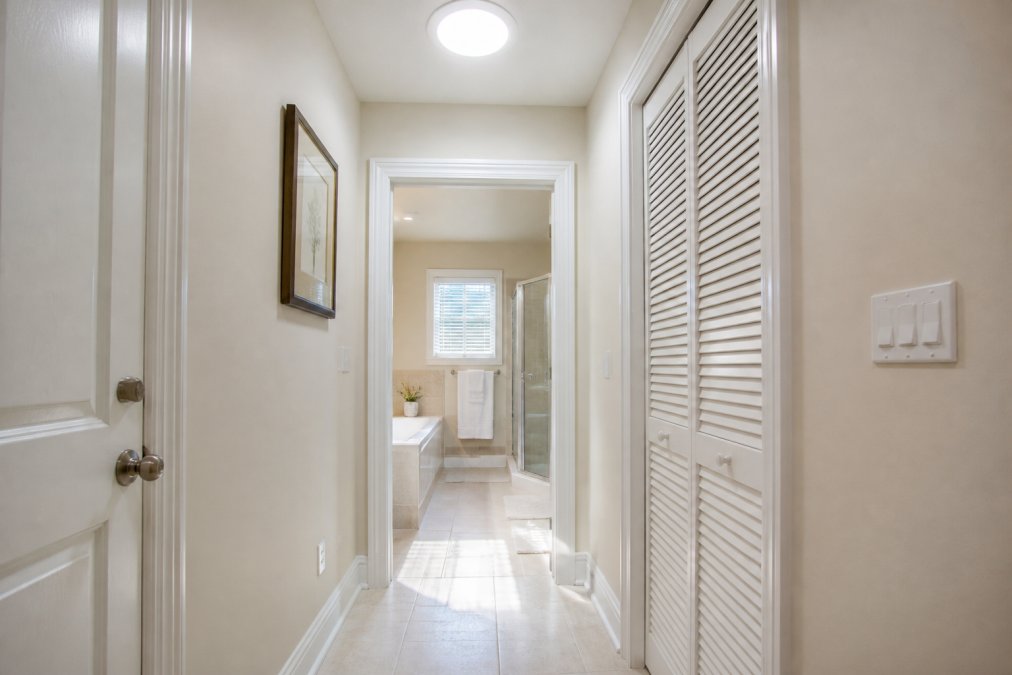
Kitchens and living rooms can benefit too, but only if you’re after light rather than a view. If you want to see sky, a tubular system won’t deliver that.
Leaks, Maintenance, and the Roof Questions Homeowners Ask
Leaks are the number one worry, and it’s a fair one. A tubular skylight leaks for the same reason any roof penetration leaks: poor flashing. Done correctly, with a proper flashing kit and a sealed moisture barrier, the risk is low.
Seal degradation is the long-term issue most guides ignore. The flashing and seals that keep water out won’t last forever, and after years of sun and storms they can dry, crack, or pull away. A quick annual check catches most problems before they become leaks.
Skipping the flashing kit to save money is the most common cause of leaks. A cheap seal fails within a few seasons, and the repair costs more than the kit would have.
HOA Rules, Smart Lighting, and the Angles Most Guides Skip
Two things trip up buyers more than anything else: HOA approval and the smart lighting question.
Many HOAs restrict roof modifications, including skylights. Check your covenants before you sign a contract, and get written approval if it’s required.
On the smart lighting side, a tubular skylight doesn’t dim on command, but you can pair it with a smart dimmer switch on the room’s existing fixtures. The daylight does the heavy lifting during the day; the smart switch handles the evening, daylight harvesting without rewiring the tube itself.
The best tubular skylight is the one installed by a certified crew with proper flashing, a short tube run, and HOA approval in hand before the first cut.
If your home has dark hallways, cave-like bathrooms, or closets you light all day, the question isn’t whether tubular skylights are worth it. It’s why you’re still paying to light rooms the sun could handle. Tubular Sun is a Solatube Premier Dealer with Certified Installation Consultants who handle the flashing, the tube routing, and the cleanup, often in a single two-hour visit, and we also install high-performance attic and garage fans, including Cat 5 rated options, to cut heat, moisture, and odors. Get started with Tubular Sun and a free consultation, and see how much brighter your home can be.
Frequently Asked Questions
What are the disadvantages of sun tubes?
The main drawbacks are that you cannot see the sky through them, they deliver a fixed amount of light with no view, and they depend on roof space and attic routing. A tubular skylight also needs a clear path between roof and ceiling, so rafter spacing and roof pitch can limit placement. Brightness varies through the day, and some homeowners add a dimmer switch to control glare. None of these are dealbreakers, but they are worth weighing against the cost of installing tubular skylights before you commit.
How long do tubular skylights last?
The roof flashing and dome are the parts exposed to weather, so their lifespan tracks the quality of the flashing kit and the seal around the roof penetration. Inside, the reflective tubing and diffuser have no moving parts and generally outlast the roof itself. The practical maintenance item is the seal, which can degrade over years of sun and rain. Having a certified installer check the flashing during routine roof inspections is the simplest way to catch a problem early.
Do tubular skylights leak?
A correctly flashed and sealed unit should not leak, but leaks usually trace back to installation rather than the product. A proper flashing kit matched to your roof pitch, plus a sound moisture barrier around the roof penetration, is what keeps water out. That is why tubular skylight installation time and installer skill matter more than the brand on the box. Ask any provider how they handle flat roofs, existing damage, and warranty coverage before you sign.
Can you install a tubular skylight in any room?
Most rooms with attic space above them can take a tubular skylight, including bathrooms, hallways, closets, laundry rooms, and garages. The limiting factors are roof pitch, rafter spacing, and whether a clear light tunnel can run from the roof to the ceiling diffuser. Rooms under a second story or with no accessible attic are harder. A quick on-site assessment tells you whether your specific room qualifies and how much daylight you can realistically expect.