
How to Brighten Dark Windowless Rooms: 7 Proven Fixes
Table of Contents
- Start With a Room Audit: Measuring Light and Identifying Dead Zones
- Layer Your Lighting: Ambient, Task, and Accent for Windowless Rooms
- Tubular Skylights for Windowless Rooms: Bringing Daylight Indoors
- Brightening Dark Hallways Without Windows: Mirrors, Glass, and Reflective Surfaces
- Paint, Furniture, and Flooring Choices That Reflect Light
- Rental-Friendly and Budget-Conscious Fixes You Can Do This Weekend
- Frequently Asked Questions
Last Updated: September 14, 2026
Start With a Room Audit: Measuring Light and Identifying Dead Zones
Before buying a single lamp, walk the room and find where light actually fails. Most people guess, buy three things, and still sit in gloom.
A room audit takes about 15 minutes. Stand in each corner at midday and again at dusk. Note which surfaces stay dark, which walls face the door, and where shadows pool. Those are your dead zones.
Here’s what most guides miss: the problem is rarely a lack of fixtures. It’s that light has nowhere to bounce. Dark walls, heavy furniture, and cluttered surfaces absorb whatever you add.
Work through these steps:
- Identify the room’s darkest corner and its brightest point
- Note the wall colors and whether they lean warm or cool
- Check what light enters from adjacent rooms
- List every surface that could reflect light (glass, metal, gloss paint)
- Mark where a fixture could realistically go
Once you know your dead zones, every fix below has a target. At Tubular Sun, we run this same audit before recommending daylighting, because a room’s shape and ceiling height decide what will work.
Layer Your Lighting: Ambient, Task, and Accent for Windowless Rooms
Light layering is the practice of combining three light types in one space: ambient for overall brightness, task for focused work, and accent for depth. One ceiling fixture cannot do all three jobs.
Ambient lighting fills the room. Task lighting serves a specific activity, like a desk or reading chair. Accent lighting adds visual depth by washing a wall or highlighting an object. Windowless rooms need all three because there’s no natural light to fall back on.
The practical setup:
- Ambient: a ceiling fixture or two floor lamps aimed at the ceiling
- Task: a desk lamp or under-cabinet strip where you actually work
- Accent: a wall sconce or small uplight behind a plant or shelf
Add dimmer switches to every fixture. You’ll want lower light in the evening, and dimmers let one room shift from bright workspace to calm living area without rewiring.
Choosing the Best Lighting Temperature for Dark Rooms
The best lighting temperature for dark rooms is 3000K to 4000K, a range often called warm white to cool white. This range reads as bright and clean without the harsh blue cast of daylight bulbs.
Color temperature is measured in Kelvin. Lower numbers (2700K) look yellow and cozy. Higher numbers (5000K+) look blue and clinical. For a windowless room, 3000K in living areas and 4000K in kitchens or workspaces keeps things bright but livable.
Buy bulbs labeled “90+ CRI” (color rendering index). In a windowless room, high-CRI bulbs make skin tones and fabrics look natural instead of gray. Most people never check this, then wonder why the room feels off.
Tubular Skylights for Windowless Rooms: Bringing Daylight Indoors
A tubular skylight is a daylighting system that captures sunlight on the roof and pipes it down a reflective tube into a ceiling diffuser, delivering natural light to rooms with no windows. Installation typically takes a few hours for a standard unit.
This is the only fix on this list that gives you actual daylight rather than a simulation. The tube runs through the attic space, so it works for hallways, bathrooms, closets, and interior rooms where a window is impossible.
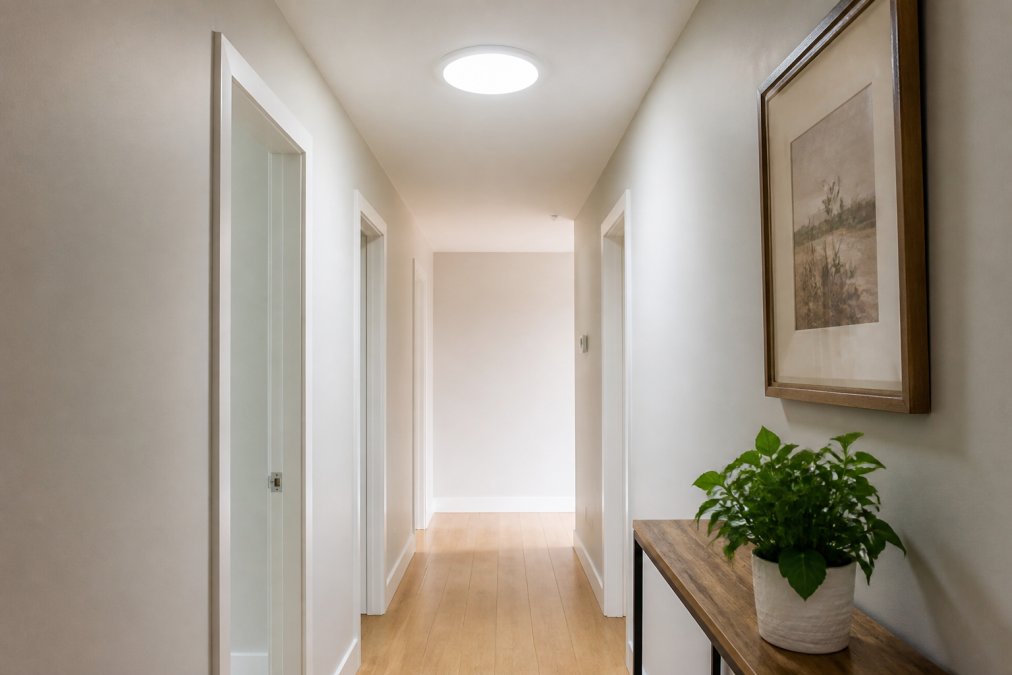
The U.S. Department of Energy guide to daylighting notes that daylighting can cut electric lighting energy use while improving occupant comfort. For dark interior rooms, that combination matters.
Tubular Sun installs these systems as a Solatube Premier Dealer. Certified Installation Consultants handle the roof work and flashing, which is where leaks usually originate. A fast, often two-hour installation means less disruption, and proper flashing protects your roof rather than compromising it.
If you have a flat roof with existing damage, ask about it during the consultation. A qualified installer will assess the roof before cutting anything.
Brightening Dark Hallways Without Windows: Mirrors, Glass, and Reflective Surfaces
Brightening dark hallways without windows comes down to reflection and borrowed light. A mirror doesn’t create light, but it doubles whatever reaches it and adds visual depth to a narrow space.
Hang a large mirror on the longest wall, opposite the brightest doorway. Position it to catch light from an adjacent room and bounce it down the hall. One well-placed mirror often does more than two extra fixtures.
Glass partitions and French doors let light pass between rooms instead of stopping at a wall. If a hallway borders a brighter living room, a glass panel in the shared wall borrows that light permanently.
Reflective surfaces extend the effect:
- High-gloss paint on trim and doors
- Mirrored furniture or a glass console
- Polished metal accents like a brass frame or chrome sconce
- Light-colored flooring with a satin finish
Keep hallways clear. A cluttered corridor reads as dark no matter how many fixtures you add.
Paint, Furniture, and Flooring Choices That Reflect Light
Light reflectance value, or LRV, measures how much light a surface bounces back on a 0 to 100 scale. Whites sit near the top, deep colors near the bottom. Choosing high-LRV finishes is the cheapest way to brighten a windowless room.
Paint the ceiling the brightest white you can find, ideally with a flat finish. Ceilings bounce light down into the room, and a flat finish avoids glare. Walls work well in a light neutral or a monochromatic scheme where wall, trim, and ceiling sit in the same family.
Flooring and furniture follow the same logic. Light-colored furniture has less visual weight, so the room feels more open. A high-gloss finish on a table or cabinet reflects the room back at itself.
| Element | Best Choice | Why It Works |
|---|---|---|
| Ceiling | Flat bright white | Bounces light downward |
| Walls | Light neutral, high LRV | Reflects rather than absorbs |
| Flooring | Light wood or pale tile | Reduces visual weight |
| Furniture | Light upholstery, gloss finishes | Reflects ambient light |
| Trim | Semi-gloss white | Adds crisp reflected highlights |
The EPA’s indoor air quality guidance also favors lighter, low-VOC finishes in enclosed rooms, since windowless spaces ventilate poorly. Brighter paint and cleaner air solve two problems at once.
Rental-Friendly and Budget-Conscious Fixes You Can Do This Weekend
Renters can brighten a windowless room without touching the walls, the ceiling, or the roof. Every fix below is reversible, and the tiers are organized by what you actually spend, not by vague “budget” and “premium” labels.
Zero-Cost Fixes (Do These First)
Before spending anything, rearrange what you already own. These moves cost nothing and often outperform a new lamp.
- Move the brightest floor lamp you own into the darkest corner and aim it at the ceiling. Upward bounce spreads light across the whole room instead of pooling it on one surface.
- Pull furniture away from the walls by 2-3 inches. Gaps let light travel around pieces instead of dying against them.
- Clear windowsills, shelves, and the tops of cabinets. Every object casts a shadow, and in a windowless room those shadows compound.
- Open every interior door along the path to the brightest adjacent room. Borrowed light is free light.
- Swap heavy dark curtains on interior doorways for nothing at all, or tie them back during the day.
Low-Budget Fixes (Under About $100 Total)
These are the highest-return purchases for a windowless rental. None require drilling, and all come out clean when you move.
- Plug-in wall sconces with adhesive mounting. Look for models with a fabric cord cover so the cord reads as intentional rather than temporary. Mount two at eye level on the darkest wall, roughly 60-66 inches from the floor.
- A daylight-balanced floor lamp. Choose one rated 3000K-4000K with a dimmable LED. Aim the shade at the ceiling for ambient bounce, or at a wall for a wash of light.
- A leaning mirror, at least 30 inches wide. Wider mirrors reflect more of the room. Lean it against the wall opposite the brightest doorway so it catches and throws light back down the space.
- Peel-and-stick mirror tiles. These work on closet doors, cabinet fronts, and the backs of bookshelves. They are not a substitute for a large mirror, but they break up dark planes cheaply.
- A sheer panel on an interior doorway. A tension rod plus a translucent curtain diffuses borrowed light from a brighter room without blocking the doorway.
Mid-Range Fixes (A Few Hundred Dollars)
At this tier you start layering light instead of just adding it.
- Add a second floor lamp on the opposite side of the room from the first. Two sources at different heights eliminate the single-shadow look that makes a room feel flat.
- Install dimmer plugs or smart plugs on every lamp. Being able to drop from bright to warm without unplugging anything is what makes a windowless room livable at night.
- Add an under-cabinet or under-shelf LED strip in a kitchen or workspace. Task light at counter height does more for perceived brightness than a stronger ceiling fixture.
- Upgrade to 90+ CRI bulbs throughout. In a room with no daylight, color rendering is what keeps skin tones and fabrics from looking gray.
The Circadian Angle Most Rental Guides Skip
Your body uses light color and timing to set its internal clock. In a windowless room, you get none of the natural cues that signal morning and evening, which is why these spaces often feel disorienting to sleep in.
The practical fix is to mimic the daylight cycle with the lamps you already have:
- Morning: a bright 4000K-5000K lamp near where you get ready, on within 30 minutes of waking.
- Afternoon: keep ambient light steady and bright; avoid dimming too early.
- Evening: switch to 2700K lamps and dim them at least an hour before bed.
The NIH research on circadian rhythm and light explains how light exposure shapes that cycle. A plug-in dimmer and two bulb temperatures are enough to run the whole sequence.
Skip “daylight” bulbs above 5000K in a room you use at night. The blue-heavy light suppresses melatonin and disrupts sleep. Save the coolest bulbs for morning workspaces.
What Renters Should Not Bother With
- Painting the ceiling or walls unless your lease allows it and you plan to stay past the deposit window.
- Adhesive “skylight” decals. They read as stickers up close and do not bounce real light.
- Full-spectrum bulbs marketed as daylight replacements. Color temperature and CRI matter more than the marketing label.
The permanent daylighting fix, a tubular skylight, is the one upgrade that adds real natural light rather than imitating it. It requires roof access, so it is a homeowner project, not a rental one.
Frequently Asked Questions
How do I lighten up a dark room with no windows?
Start with layered artificial lighting: an overhead fixture for ambient light, floor lamps for task lighting, and wall sconces for accent glow. Choose bulbs at 3000K to 4000K, which mimic natural daylight without feeling harsh. Add mirrors on adjacent walls to bounce light around the space. If you own your home, tubular skylights for windowless rooms can deliver real daylight through a roof-mounted dome and reflective tube, often installed in about two hours by a certified consultant.
Can tubular skylights be installed in windowless rooms?
Yes. Tubular skylights are designed specifically for rooms without windows or with limited exterior wall access. A small dome on the roof captures sunlight, and a highly reflective tube channels it down through the ceiling into the room. Installation typically takes about two hours and works with both pitched and flat roofs. A Solatube Premier Dealer can assess your roof type and confirm whether your space qualifies during a free consultation.
What is the best lighting temperature for dark rooms?
The best lighting temperature for dark rooms falls between 3000K and 4000K. Warm white (2700K to 3000K) creates a cozy feel but can make dark rooms feel dimmer. Cool white (4000K to 5000K) mimics daylight and helps small or windowless spaces feel larger and more alert. Avoid bulbs above 5000K in living areas because the blue tint can feel clinical. Use dimmer switches so you can adjust throughout the day.
How can I brighten a dark hallway without windows on a budget?
Brightening dark hallways without windows does not require a renovation. Hang a large mirror on one wall to double the perceived light. Swap heavy curtains for translucent panels if there is any nearby doorway light. Add a slim console table with a table lamp using a 4000K LED bulb. Paint the hallway in a light, warm-neutral color with a high light reflectance value. These changes can transform a cave-like corridor in an afternoon.
A dark, windowless room doesn’t have to stay a cave. Start with the audit, layer your lighting, and reflect what you can. When you’re ready for actual daylight instead of a workaround, Tubular Sun installs Solatube daylighting systems with Certified Installation Consultants, fast two-hour installations, and proper roof flashing that protects your home. Book a free consultation with Tubular Sun and turn your darkest room into the brightest one.