
How to Choose the Right Tubular Skylight for Your Home
Last Updated: November 24, 2026
Quick Summary
The right tubular skylight depends on the room’s size and daylight need, your roof’s orientation and framing, and the length of the tube run. Start by matching the tube diameter to the room, then have an installer model the specific run before buying.
- Choose tube diameter by room: about 10 inches for small spaces, 14 inches for bedrooms and offices, 21 inches for kitchens and living areas.
- Keep tube runs short and straight, since every foot and bend reduces the light reaching the ceiling.
- Confirm roof framing, material, attic clearance and condition before choosing a model.
- Ask for installed costs broken into components, and check whether flashing and attic repair are included.
Table of Contents
- How to Choose a Tubular Skylight for Your Home
- Matching Tubular Skylight Sizes to Your Rooms
- Checking Roof Compatibility and Installation Risk
- Tubular Skylight Installation Cost and Payback in Southwest Florida
- Solatube vs. VELUX: Which Tubular System Fits Your Home
- VELUX Sun Tunnel Installation: What to Expect
- Book Your Free Consultation with Tubular Sun
- Frequently Asked Questions
How to Choose a Tubular Skylight for Your Home
Choosing the right tubular skylight comes down to three things: the size of the room, the roof you have, and how much light you actually need. Tubular Sun, a Solatube Premier Dealer in Southwest Florida, helps homeowners work through these choices. Our Certified Installation Consultants start with the room, not the product catalog.
Most homeowners start with a dark hallway, bathroom or closet. A tubular skylight, sometimes called a sun tunnel or light tube, captures daylight through a roof dome, carries it down a reflective tube and releases it through a ceiling diffuser. The right system fits your space, roof and budget.
A common mistake is buying the largest tube available. A wide tube can wash out a small room, while a narrow tube may barely change the light level in a large one.
Matching Tubular Skylight Sizes to Your Rooms
Start by listing each room you want to brighten, along with its approximate size and ceiling height. Small rooms such as bathrooms, closets and hallways usually need one tube with a modest diameter. Larger spaces like kitchens or family rooms may need more than one unit to spread light evenly.
Room size is only part of the picture. Roof pitch, orientation and tube run length all affect how much light reaches the ceiling. A north-facing roof gets less direct sun than a south-facing one, so that side may need a wider tube or a dome designed to collect more light.
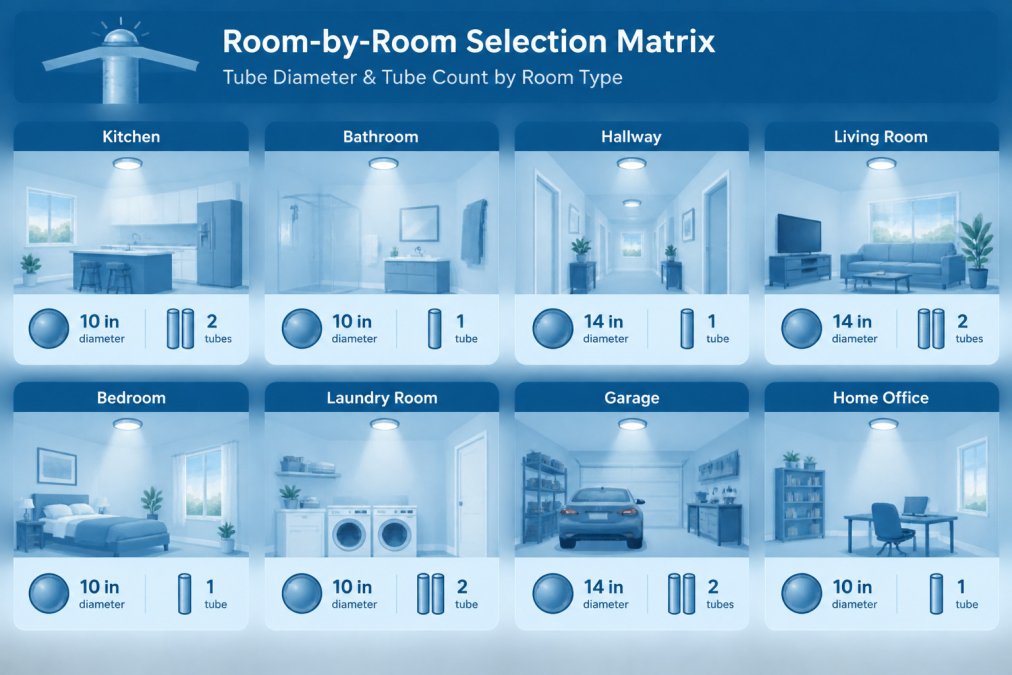
A room-by-room selection matrix
Use this matrix as a starting point, then adjust for roof orientation, tube length and bends. Match the tube to the room’s daylight need, not the biggest tube available.
| Room type | Typical floor area | Ceiling height | Daylight need | Starting tube diameter | Number of tubes |
|---|---|---|---|---|---|
| Hallway or closet | Under 50 sq ft | 8 ft | Low to moderate | 10 in | 1 |
| Bathroom | 40-100 sq ft | 8-9 ft | Moderate | 10-14 in | 1 |
| Bedroom | 100-200 sq ft | 8-9 ft | Moderate | 14 in | 1 |
| Home office | 100-150 sq ft | 8-9 ft | Moderate to high | 14 in | 1 |
| Kitchen | 150-300 sq ft | 8-10 ft | High | 14-21 in | 1-2 |
| Family room or living area | 250-500 sq ft | 9-10 ft | High | 21 in | 2 or more |
| Open-plan great room | Over 500 sq ft | 10 ft or higher | High | 21 in | 2-3, spaced evenly |
Starting tube diameter
Treat the matrix as a starting point, not a guarantee. A 14-inch tube in a north-facing bedroom with a 20-foot run and two elbows delivers less light than the same tube in a south-facing bedroom with a short, straight run. Ask your installer to model the specific run before you commit.
Tube diameter and light output
Tube diameter is the main factor in how much light a system delivers. Wider tubes move more light but also cost more and take up more space in the attic.
- Smaller diameter (about 10 inches): Suits bathrooms, closets and short hallways. Lower cost, easier installation in tight attics.
- Medium diameter (about 14 inches): A good fit for most bedrooms and offices. Balances brightness with cost.
- Larger diameter (about 21 inches): Best for kitchens, living areas and rooms that get little natural light.
Light output also drops as you add length and bends. A system that looks bright on paper may disappoint in a dark room if the run is long.
Watch out: Do not judge brightness by the diameter alone. Ask your installer for the expected light output for your specific roof, tube length and room, not a generic figure.
Tube length and bends
Every foot of tube and every bend reduces the light that reaches the ceiling. Short, straight runs deliver the most light. Long runs through a crowded attic, or runs with several elbows, lose more.
- Short runs (under 10 feet): Preserve the most light. Ideal when the room sits directly below the roof.
- Medium runs (10 to 20 feet): Common in single-story homes with some attic space.
- Long runs (over 20 feet): Possible, but expect a noticeable drop in brightness. Often better suited to a second tube.
Pros and cons by length:
| Tube Length | Pros | Cons |
|---|---|---|
| Short | Brightest result, simpler install | Limited to rooms below the roof |
| Medium | Flexible placement, good balance | Some light loss from bends |
| Long | Reaches interior rooms | Dimmer output, more materials |
Realistic light-output expectations
Brightness depends on conditions. In a real home, several factors change what you see at the diffuser:
- Cloud cover: Overcast days cut perceived brightness noticeably. A tube sized for a sunny day may feel dim in a rainy season.
- Roof direction: South-facing domes collect the most direct sun over the year in most U.S. climates; north-facing domes collect more diffuse light and deliver a cooler, steadier level.
- Season and sun angle: Winter sun sits lower and may be blocked by neighboring roofs, trees or gables. Summer sun is higher and often brighter at midday.
- Tube length and bends: Each elbow and every additional foot reduces transmission. A long, bend-heavy run can lose a meaningful share of the light captured at the dome.
- Obstructions: Chimneys, HVAC equipment, trees and adjacent buildings can shade the dome for part of the day.
Ask your installer which sizing approach suits the room’s typical conditions, and whether a second tube would help on overcast days.
Checking Roof Compatibility and Installation Risk
Before choosing a model, confirm your roof can take a tubular skylight. Roofs with existing damage need a closer look before any cutting begins.
Check these points with your installer:
- Roof framing: Confirm rafter spacing and whether the attic has room for the tube run.
- Roof material: Shingle, tile and metal roofs each need specific flashing and sealing.
- Attic clearance: Make sure there are no ducts, wiring or framing blocking the path.
- Existing condition: Old leaks, soft decking or rot must be repaired before installation.
- Roof age: An older roof may need replacement first, since a skylight is a poor investment on a failing surface.
A common concern is leaking (Flashing around a Skylight with Roof Removal). Poor flashing and weak sealing cause most skylight leaks, not the tube itself. Ask whether the installer uses a flashing kit designed for your roof type and whether the work is covered by a warranty.
Tubular Skylight Installation Cost and Payback in Southwest Florida
Installation cost depends on quantity, tube length, roof type, attic access and the number of rooms served. For current prices, visit the Tubular Sun pricing page or request a quote.
What we can do is show you how the total is built, so you can compare quotes line by line instead of lump sum to lump sum.
How the installed cost breaks down
A tubular skylight quote can combine several cost components. Ask for them to be separated:
A single-total quote makes it hard to tell whether you are paying for a premium product or difficult roof access. Separating the buckets lets you compare apples to apples.
What drives your number up or down
Watch out: A quote that is noticeably lower than the others often excludes flashing, attic repair or permit costs. Ask what is not included before you compare totals.
Payback: when the math works and when it does not
Savings depend on how often you run artificial lights, how hot your attic gets and your local electricity rates. Ask for an estimate based on your home.
A realistic way to think about payback:
Whether a tubular skylight pays for itself depends on how many rooms you light and how much you rely on lamps during the day.
Questions to ask before you sign
- Is the flashing kit included, and is it rated for my roof material?
- Are attic repairs, decking replacement or painting included or billed separately?
- Is the warranty on materials, labor, or both, and who honors it?
- Does the quote include permit fees if your jurisdiction requires one?
- What is the expected light output for my specific run, not a brochure figure?
U.S. Department of Energy guidance on daylighting and skylights
Solatube vs. VELUX: Which Tubular System Fits Your Home
Solatube and VELUX both make daylighting systems. The right choice depends on your roof, budget and what you value most.
Compare the two on these criteria:
Tubular Sun is a Solatube Premier Dealer. Ask any installer which system they are certified to fit and whether they support its warranty, and ask which option suits your framing and roof.
VELUX Sun Tunnel Installation: What to Expect
Plan for these points:
- Confirm the installer is trained on the specific VELUX model.
- Ask how the roof penetration will be flashed and sealed.
- Find out what the warranty covers for both materials and labor.
- Check whether the diffuser matches the room’s ceiling style.
Book Your Free Consultation with Tubular Sun
Choosing a tubular skylight is easier with the right measurements and an honest assessment of your roof. Our Certified Installation Consultants can review your rooms and discuss your options before you commit.
Contact Tubular Sun for a free consultation to find out which system brightens your home best. Solatube daylighting systems are offered with fast installation, so you can enjoy more natural light sooner.
Frequently Asked Questions
Which tube skylight is the best?
No single tubular skylight is best for every home. The right choice depends on the room size, roof pitch, and how much light you need. The room size and roof conditions both matter when choosing a tube. Ask an installer to confirm the fit for your specific rooms and roof before you buy.
Which is better, Solatube or VELUX?
The right tubular system depends on the layout of your home. A professional installer can explain which system fits your roof and ceiling conditions.
How much does it cost to install a tubular skylight?
Tubular skylight installation pricing depends on the number of units, the roof work involved, the tube length, and the accessories you choose. Visit the Tubular Sun pricing page for current information, or request a free consultation to get a quote for your home.
What size tubular skylight do I need?
Tube diameter and length determine how much light reaches the room below. Wider tubes and shorter runs deliver more daylight, while longer tubes with bends reduce brightness. Match the size to the room: a consultation can discuss the right size based on your roof and ceiling height.

